


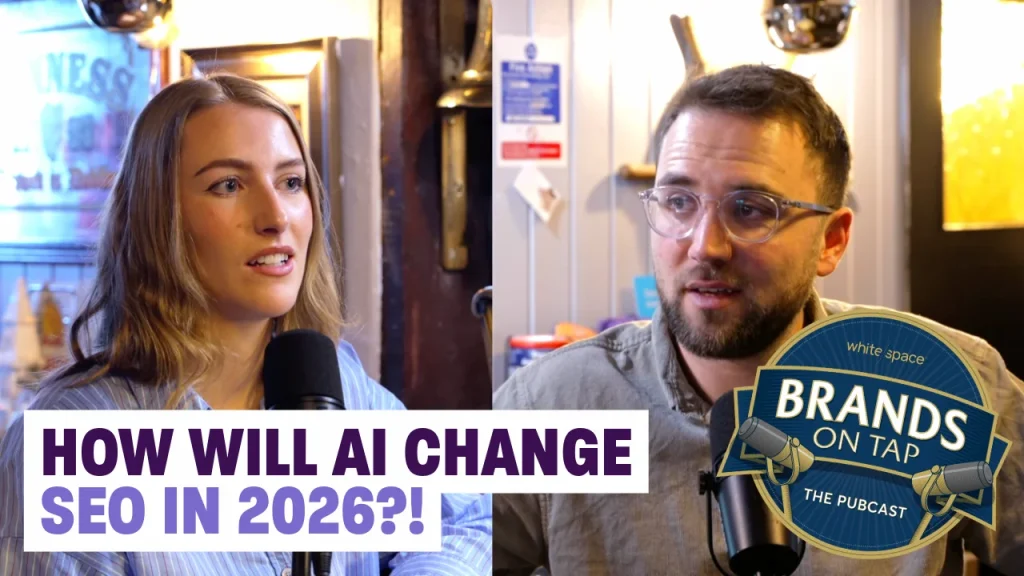
What this episode covers
In this episode of Brands on Tap, Rob and Jaz unpack the foundations of SEO that still matter in 2026 before diving into AI, GEO and what to do differently this year. They frame SEO not as “just SEOing a website”, but as a strategic process that connects keyword research, content, technical build and off-site signals directly to business goals.
SEO strategy foundations in 2026
They outline how modern SEO demands clear objectives, keyword mapping and content designed around real search intent rather than a tick-box exercise. The episode stresses that effective SEO is complex and joined-up, requiring alignment between strategy, UX, content and measurement from day one.
Traditional SEO, keywords and content
The discussion begins with traditional SEO: keyword-focused, search-led content that balances brand voice with the phrases people actually use, instead of relying on pure copywriting alone. Rob and Jaz explain how researched keywords, clear intent (informational vs transactional), solid site structure, headings, internal linking, image optimisation and schema work together so search engines understand exactly what each page is for.
Technical SEO, site structure and schema
They then move into technical SEO and site architecture, covering semantic HTML, consistent URLs, logical sitemaps and schema/rich snippets as ways to “handhold” both search engines and AI systems. Schema is positioned as an amplifier, not a silver bullet; it only delivers value when the underlying content, structure and user experience are already strong.
Off-page SEO, backlinks and authority
The conversation shifts to off‑page SEO and backlinks, where quality beats quantity every time. They contrast low‑quality link farms with high‑authority “premium” links from reputable publishers, emphasising that even no‑follow links can drive powerful brand awareness, referral traffic and perceived authority when placed in the right context.
Local SEO, Google Business and location pages
Local SEO receives its own focus, including advice on Google Business Profiles, reputable local directories and location or service‑area pages that prove relevance and trust in specific regions. For local brands, they argue that ranking for local intent queries is far more valuable than chasing broad, national keywords that attract the wrong traffic and rarely convert.
How AI is changing search behaviour
Rob and Jaz then explore how AI is changing search behaviour, with users now searching in more conversational, question-led ways across social platforms and LLMs like ChatGPT, Perplexity and Copilot, as well as Google. AI answers often feel more “qualified” because the system has a dialogue with the user before recommending a narrower set of options, reshaping how discovery and qualification happen.
Generative Engine Optimisation (GEO) and AI Overviews
This naturally leads into Generative Engine Optimisation (GEO): optimising so your brand is cited or recommended inside AI answers and Google’s AI Overviews. Practical GEO tips include doubling down on long‑tail, question‑driven, informational content, using clear structure and schema, and building credible off‑site signals that appear consistently wherever AI systems look for supporting evidence.
AI content, “good enough” SEO and the 80/20 rule
A major part of the episode tackles AI content, “good enough” SEO and the risk of penalties. The hosts argue against lazy, fully generated copy, positioning AI as a support tool for research, outlines, drafts and schema scaffolding rather than a substitute for subject‑matter expertise and brand perspective, and recommend an “80/20” split for 2026: around 80% human‑driven strategy and refinement, backed by 20% AI assistance.
Measuring SEO and GEO in an AI-driven world
Measurement in an AI‑driven landscape is another key theme, with a push to look beyond vanity metrics like raw traffic and total backlinks. They advocate focusing on conversions from organic search, lead quality and trust indicators, while beginning to track emerging signals such as AI citations and visibility wherever possible.
Trust, authenticity and SEO in 2026
Throughout, the recurring message is that trust and authenticity are now essential differentiators as AI content saturates the web and audiences grow more sceptical. Brands that demonstrate real work, real results and real people—through case studies, social proof, rich media backed by evidence and consistent expert positioning—will be best placed to win clicks, recommendations and conversions in 2026’s AI-shaped search landscape.