




Marketing budgets are among the most critical decisions a business makes each year, yet many companies get them wrong. Allocate too little, and you’ll struggle to reach your audience and achieve any tangible results. Spend too much without a clear strategy, and you’re wasting resources that could impact your bottom line. Meanwhile, some businesses don’t even assign an annual marketing budget, or do so without a calculation, leading to poor outcomes.
The average company allocates 5-12% of total revenue to marketing, but the right figure for your business depends on multiple factors, such as your industry, growth stage, business model, and specific objectives.
The good news? There’s no single “perfect marketing budget”. Instead, there are proven calculation methods that work for different situations.
In this Insight, we’ll walk you through each approach, show you examples of how it is applied, help you determine which method makes sense for your business, and share tips on common marketing budget mistakes to avoid.
Why Your Marketing Budget Matters
Before we dive into the numbers, it’s worth understanding why getting your marketing budget right is so critical.
A well-calculated budget aligns spending with business objectives rather than relying on hunches or tradition. It ensures you can measure return on investment (ROI) across channels, prevents overspending or leaving money on the table, scales proportionally as your business grows, and allows flexibility to test new channels and tactics.
Most businesses fail at budgeting because they either reverse-engineer a number based on what they feel are available funds, or they default to “what we spent last year.” Neither approach accounts for your actual marketing needs or market opportunities and lead to unnsuccessful business results. After all, what’s the point in investing into marketing if you aren’t going to assign an appropriate budget to achieve results.
The 5 Main Methods for Calculating Annual Marketing Budget
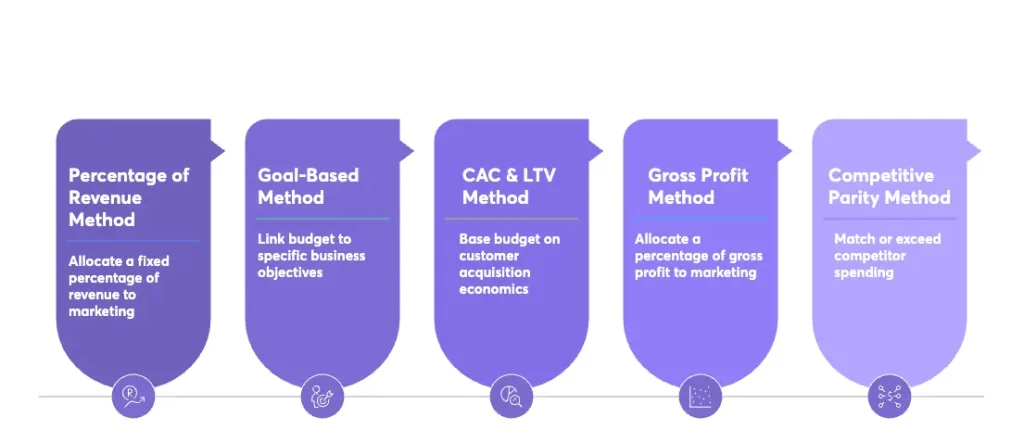
1. Percentage of Revenue Method (Most Common)
How it works: Allocate a fixed percentage of your company’s revenue – either from the previous year or projected for the coming year – to marketing.
The formula: Annual Marketing Budget = Annual Revenue x Target Percentage
Here is an example:
- Company revenue = £1,000,000
- Target percentage = 8%
- Marketing budget = £80,000
Industry Benchmarks for this method:
| Business Type | Recommended Percentage |
|---|---|
| B2B Services | 2-5% |
| B2C Retail/E-commerce | 5-10% |
| Startups (High-growth) | 10-30% |
| Mature SMBs | 5-10% |
| Enterprise | 7-15%+ |
This method is popular because it’s straightforward and scales naturally as your business grows. You have predictable revenue, clear benchmarks against industry, and it’s easy to adjust year-on-year based on performance and growth ambitions.
However, the revenue percentage approach doesn’t account for growth ambitions or strategic shifts. It treats marketing as an expense rather than an investment, which can limit strategic thinking. It is essential to review this approach annually, assess market changes, and account for realistic future growth in line with your business plan.
2. Goal-Based Method
How it works
Start with your business objectives, identify the tasks needed to achieve them, estimate the cost of each task, and sum them up. This method directly links your budget to measurable outcomes.
The formula
Annual marketing budget = Sum of all task costs to achieve objectives
The step-by-step process is:
- Define your goal (e.g. Generate 500 new qualified leads)
- Identify required marketing channels (e.g. PPC campaigns, content marketing, email marketing)
- Estimate cost per task (e.g. £2,000 per month for Google Ads)
- Calculate the total annual cost for each channel
- Add operational costs (e.g. staff, agency, tools, and subscription costs)
- Sum all costs for your total budget
This approach forces you to think strategically about which channels and tactics truly matter. It directly links budget to business objectives, making it easier to defend spending decisions to leadership and better aligning spend with ROI expectations.
The trade-off is that it’s more time-intensive to calculate accurately and requires historical cost data per channel.
It’s important to know this method works best when combined with your available budget. If your calculated budget exceeds available funds, reverse-engineer it by prioritising high ROI marketing activities first.
For startups without a performance history, it can be challenging to estimate costs reliably, and therefore, the percentage-of-revenue method is recommended.
3. Customer Acquisition Cost (CAC) & Lifetime Value Method (LVM)
How it works
Base your budget on the economics of customer acquisition. Calculate how much you can afford to spend acquiring each customer while maintaining profitability and sustainable growth.
The formula
- Target CAC = Customer Lifetime Value ÷ 3
- Total Marketing Budget = Target New Customers × Target CAC
The step-by-step process is:
- Calculate average customer lifetime value (e.g. £3,000)
- Apply a healthy CAC ratio (e.g. 3:1, a customer generates 3x what you spend)
- Set a target CAC (e.g. £3,000 ÷ 3 = £1,000 per customer)
- Calculate target number of customers needed (e.g. 200)
- Calculate marketing budget (e.g. 200 x £1,000 = £200,000)
The CAC/LVM method is particularly valuable if you have historical customer data and want to maintain profitability while scaling. It ensures growth is sustainable and forces focus on customer economics rather than vanity metrics like impressions or clicks.
However, this approach requires accurate LTV calculations, which can take time to establish for new businesses. It also doesn’t account for brand building or long-term positioning, which are harder to quantify but still valuable.
This method works best for SaaS, subscription, and e-commerce businesses, where you can track customer lifetime value with reasonable accuracy.
4. Gross Profit Method
How it works
Allocate a percentage of your gross profit – not revenue – to marketing. This ensures you’re reinvesting profitable money back into growth without compromising overall profitability.
The formula
Annual Marketing Budget = Gross Profit x Reinvestment Percentage
The step-by-step process is:
- Annual revenue (e.g. £1,000,000)
- Costs of revenue (e.g. £400,000)
- Gross profit (e.g. £600,000)
- Reinvestment percentage (e.g. 20%)
- Marketing budget (e.g. £600,000 × 20% = £120,000)
This method prioritises profitability over growth-at-all-costs, making it ideal if you want a sustainable, long-term approach. It accounts for the actual profit available to reinvest and ensures marketing investment doesn’t compromise the bottom-line health of the business.
The limitation is that this method may allocate too conservatively for high-growth ambitions, and it can underspend in low-margin industries where customer acquisition requires significant investment upfront. This method would not be recommended for a new business start-up.
5. Competitive Parity Method
How it works
Research what competitors spend on marketing and match or exceed their investment to maintain market position. This ensures you’re competitive and provides real-world validation of your spending.
This method is useful when entering a new market or defending against aggressive competitors. It provides real-world benchmarks and helps validate other calculation methods.
The risk is assuming competitors are spending wisely – they may not be. It can also lead to budget wars without a clear strategic purpose, where you’re matching spend rather than aligning with your actual goals.
It is not recommended to use the competitive party method as your primary budgeting process. Instead use it as a way to validate and compare your spending to others as part of competitor and market analysis.
Industry-specific Marketing Budget Considerations
Small Business Marketing Budgets
Smaller businesses often require strict prioritisation. Typically smaller businesses will focus on 1-2 high ROI channels – often Google Ads and content for B2B and paid social and e-marketing for B2C. Measurable results matter immensely at this scale, as you need to ensure your budget is working hard for you and not simply being spent inappropriately on channels that don’t generate real results.
Mid-Market Marketing Budgets
With more resources, you can invest in multiple channels simultaneously, potentially build in-house expertise by hiring specialists, invest in brand building beyond performance, and test new channels more aggressively without derailing overall performance. Mid-market budgets typically support dedicated channel leads and more sophisticated measurement.
Enterprise Marketing Budgets
Large businesses typically allocate 12–15% of revenue to marketing. They invest heavily in brand positioning and thought leadership, run sophisticated omnichannel campaigns, leverage advanced analytics and marketing technology, and maintain dedicated teams or agencies for different outputs. Enterprise budgets often include significant allocations for brand building, executive visibility, and long-term market positioning.
Common Marketing Budget Mistakes to Avoid
- Seeing marketing as simply a cost and not an investment – Marketing, by definition, is to contribute to business growth and therefore just needs to be done properly.
- Basing the budget solely on what you spent last year – This doesn’t accurately reflect market opportunities or business needs. Last year’s budget was built on last year’s assumptions.
- Ignoring your actual revenue or profit capacity – Budgeting beyond what your business can afford will damage profitability and create unsustainable targets.
- Not accounting for inflation and market changes – Software costs, agency rates, and ad costs all change annually, so you must budget accordingly.
- Assuming equal spend equals equal results across channels – Different channels have different ROIs and require different investment levels. Some channels are worth 2-3x more investment than others.
- Forgetting to include staff and overhead costs – Salaries, agency, freelancer, and system costs are often the largest marketing expense, sometimes 40-50% of a total marketing budget.
- Separating marketing from sales goals – Your budget should directly support revenue targets and not exist in isolation. If sales needs 200 new customers and marketing is budgeted to generate 100, you have a misalignment problem.
The Key Takeaway
There’s no one-size-fits-all marketing budget. The right approach depends on your business model, growth stage, and objectives. Most companies spend 5–12% of revenue on marketing, but this varies dramatically by industry and growth ambitions.
The best budgets combine calculation methods. Start with a percentage of revenue or gross profit (gives you a baseline), validate it with goal-based costing (ensures sufficiency), and adjust based on customer economics (ensures sustainability).
Channel allocation matters as much as total budget. Equally, measuring your investments accurately to inform future budget allocations is a non-negotiable. Doing this correctly allows you to understand what marketing does and doesn’t work for your business and why.
Your budget is a living plan that should evolve as business conditions change. Review and adjust annually (or more frequently if your business allows) based on performance, market shifts, and new opportunities.
Ready to put your marketing budget to beneficial use?
Calculating a marketing budget is one thing, but making sure every pound delivers measurable results is another entirely. We work with businesses across industries to build marketing strategies that align with budgets and drive genuine growth.
Whether you’re allocating your first marketing budget or optimising a significant marketing portfolio, our team can help you define clear marketing objectives that tie directly to revenue, audit current spending to identify weaknesses or underutilised channels, recommend budget allocation across channels based on your specific goals and industry benchmarks, build integrated campaigns that deliver results within your constraints, and track performance with ongoing optimisation.
If you’d like to discuss your marketing budget and strategy, get in touch with us today. We’ll review your current approach and show you how to make every marketing pound count.