




Pay-Per-Click (PPC) advertising is one of the fastest ways to drive targeted traffic and leads to your business. For small and medium-sized companies, PPC offers a level playing field for online competition, allowing you to appear at the top of Google or in social feeds almost immediately by bidding on the right terms. Unlike traditional ads, PPC allows you to pay only when someone clicks through to your website, making it a highly cost-effective marketing channel.
In this guide, we’ll explain 12 ways PPC can help grow your business. We’ll also look at how different business models use PPC, a simple model to gauge PPC ROI, a 90-day starter guide, and some FAQs. By the end, you’ll see how PPC can fit into your broader digital strategy and deliver measurable results for your company.
What is PPC Advertising? (and why it works)
PPC stands for pay-per-click, a model of online advertising where you pay a fee each time someone clicks your ad. The most common platform is Google Ads (formerly AdWords), but PPC also includes Bing Ads (Microsoft Advertising), Facebook/Instagram Ads, LinkedIn Ads, and more. Essentially, PPC lets you buy visits to your site by bidding on specific keywords or audience criteria, and you in theory only pay when an interested user actually clicks.
This model is so effective because it targets people at the moment they’re searching for or browsing something related to your business. For example, if you run a local accounting firm, you can have your ad show up when someone in your area searches “accountant near me.” You’re reaching high-intent prospects who need what you offer right now, rather than showing up for a general audience and hoping it sticks.
Another reason PPC works is the control and measurability it provides. You set daily budgets, choose maximum bids for clicks, and define exactly who sees your ads (by keywords, location, time of day, etc). Every click and conversion is tracked, so you know exactly how much you spent and what you got in return, down to each lead or sale.
In fact, businesses make about £2 in revenue for every £1 spent on Google Ads, on average. It’s no surprise then that millions of companies (including over a million small businesses) invest in PPC. Google’s ad platform is so dominant that it drives about 97% of Google’s revenue, with UK businesses alone spending over £3 billion on PPC ads in a year. Clearly, many businesses see positive returns from PPC, and with the right approach, yours can too.
PPC Tip!
PPC works best as part of a broader marketing plan. Make sure it’s aligned with your overall digital strategy and SEO efforts. PPC can deliver quick wins and data insights while your longer-term organic tactics ramp up.
12 Ways PCC Helps Your Business
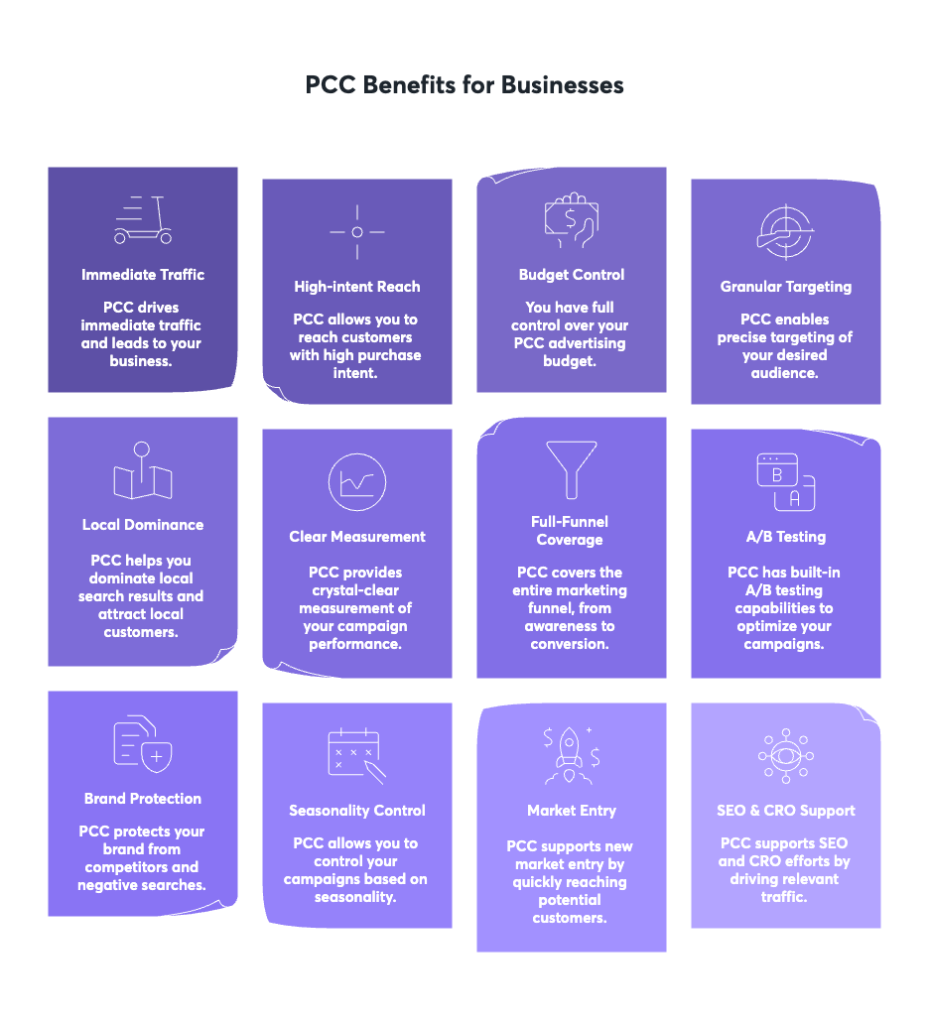
PPC isn’t just about getting clicks. It’s a tool for business growth. Here are 12 key ways PPC can help your business.
Immediate Traffic & Leads
Switch on a campaign and start generating website visitors and enquiries within days, not months. There’s no long wait; PPC ads can produce new leads this week rather than next quarter.
High-intent Reach
Capture people actively searching for what you sell. For example, bidding on specific keywords (like “emergency plumber in Birmingham” or “buy organic dog food”) puts your ad in front of users who already want those services or products. You’re meeting existing demand head-on.
Budget Control
Set your ad spend to suit your pocket. PPC lets you fix daily caps, limit bids, and schedule ads to run only at certain times. You can start small and scale up only when it’s profitable. If something isn’t working, you can pause campaigns instantly, and you’re always in control of the budget.
Granular Targeting
Focus on your ideal audience. PPC platforms allow you to filter who sees your ads by keywords, location (down to postcodes or radius targeting), device type, demographics, time of day, and more. This precision ensures your budget is spent on qualified prospects most likely to convert.
Local Dominance
If you serve a specific area or region, PPC can make you a local priority. Geo-target your ads and use location extensions (like address info and maps) to appear prominently for nearby searches. For instance, a dentist could target a 10-mile radius and show up for “dentist near me” searches, capturing local patients before they find a competitor.
Crystal-clear Measurement
With PPC you can track every penny from click to customer. Key metrics like cost-per-click (CPC), cost per acquisition (CPA), return on ad spend (ROAS), and customer lifetime value (LTV) are readily available. Conversion tracking lets you attribute sales or leads to specific keywords and ads, so you know what’s working. This data transparency makes it much easier to calculate ROI and justify your ad spend.
Full-Funnel Coverage
PPC isn’t only about search ads for ready-to-buy customers. You can cover the entire marketing funnel. Use Search ads for bottom-of-funnel demand capture (people actively looking for a product/service), Display and YouTube ads for top-of-funnel awareness, and remarketing ads to re-engage those who visited your site but didn’t convert. In short, PPC lets you both attract new prospects and nurture existing ones until they’re ready to choose you.
Built-In A/B Testing
PPC is a fantastic testing ground for marketing ideas. You can rapidly run A/B tests on ad headlines, text, images, and calls-to-action to see what resonates with your audience. Because results come in quickly, you get near-immediate feedback on what messaging or offer drives more clicks and conversions. Winners can then be rolled out not just in your ads, but across other channels (website, email, etc.) for a unified, optimised campaign.
Protect your Brand
PPC isn’t just for reaching new customers; it can defend your brand’s presence online. Unfortunately, competitors can bid on your brand name, so bidding on your own brand name ensures that when people search for your business, they see your site at the top, not a competitor’s ad. This is only typically recommended when competitors are actively bidding on you. Brand-name clicks are usually very cheap and highly likely to convert (since those searchers already intend to find you), so it’s a no-brainer. It also prevents rivals from appearing above your name with their ads. In short, you control your search results page (SERP) presence.
Seasonality Control
Does your business have busy and slow seasons? PPC lets you adjust on the fly. You can increase bids and budget around peak periods (e.g. a retailer ramping up ads before Christmas, or a florist before Valentine’s Day) to maximise your visibility when demand is highest. During quieter times or holidays, you can dial back or pause campaigns to avoid overspending when people are less active. This agility ensures you’re spending in tune with customer behaviour patterns.
New Market Entry
Expanding to a new market or testing a new product? PPC is a low-commitment way to gauge demand and get initial customers in that segment. Launch ads in the new region or for the new offering, and see how people respond. You’ll quickly gather data on click-through rates, conversion rates and interest levels. If results are promising, you’ve validated the opportunity without huge upfront investment, and if not, you can pivot or pause without incurring large costs.
Supports SEO & CRO
PPC and organic marketing go hand-in-hand. The search query data from your PPC campaigns can reveal which keywords drive the best results, informing your SEO strategy (so you can target those terms organically). Likewise, PPC traffic allows you to test landing page variations and improve conversion rate optimisation (CRO). If one ad landing page converts better, use those insights to tweak your website for all traffic. Over time, the lessons learned from PPC make your entire digital marketing more effective.
As these points show, PPC is a multi-faceted channel that can drive quick wins, long-term gains, and everything in between. The impact can be dramatic when campaigns are managed well.
PPC Use Cases by Business Model
Almost any type of organisation can benefit from PPC, but the approach may differ. Here are a few examples of how PPC strategy is tailored to different business models:
Local Services
Businesses like tradespeople, clinics, or emergency services rely on immediacy and proximity. PPC lets you target “urgent” keywords (e.g. “24/7 locksmith London”) and “near me” searches. You can even run call-only ads that let mobile users phone you directly from the search results. This often leads to same-day or same-week bookings for local service providers.
E-commerce
Online retailers can use PPC to put products front and centre. Google Shopping campaigns and newer formats like Performance Max showcase your products with images, prices, and reviews, attracting shoppers who are ready to buy. Dynamic remarketing ads are especially useful if someone browsed an item on your site but didn’t purchase. You can show them that exact product (or related ones) in their social media or display feeds, reminding them to come back. This often boosts average order value and overall revenue from warm prospects.
B2B/SaaS
Companies selling B2B products or software-as-a-service face longer sales cycles and niche audiences, but PPC can still deliver highly qualified leads. Target specific high-intent keywords that include your industry or problem (e.g. “CRM software for real estate” or “compliance training platform UK”), and use the ads to drive visitors into a free demo or consultation offer. You can also layer on audience targeting (for instance, using LinkedIn data within Google Ads) to ensure you’re reaching decision-makers in the right industries. PPC will fill your pipeline with prospects to hand over to your sales team or lead nurturing system.
High-ticket or considered purchases
For expensive products or services that people research heavily (think custom home renovations, financial services, luxury items), PPC is great for lead generation. Rather than expecting an immediate sale online, the goal is to capture an enquiry form or phone call. Then, you nurture those leads via email/phone until they convert. It’s crucial to import your offline conversions (e.g., marking which leads eventually became customers and for how much) back into your PPC platform. This way, you can accurately see your true cost per sale and refine campaigns toward the most profitable keywords.
A Simple Model to Project PPC ROI
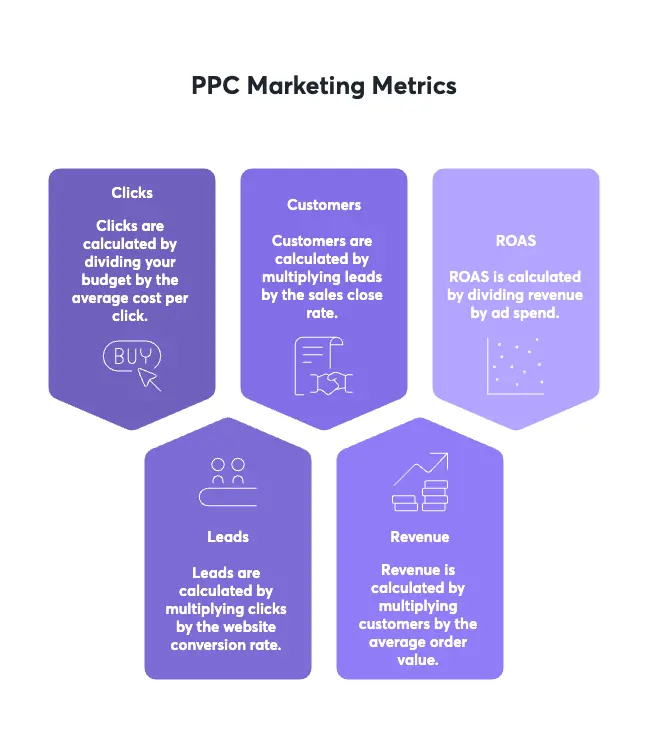
One big advantage of PPC is how measurable it is. In fact, you can forecast your potential return on investment (ROI) with a few basic numbers. Here’s a simple PPC ROI model:
- Clicks = Your Budget ÷ Average Cost Per Click (CPC).
- Leads = Clicks × Website Conversion Rate (CVR).
- Customers = Leads × Sales Close Rate (the percentage of leads you close).
- Revenue = Customers × Average Order Value (AOV).
- ROAS (Return on Ad Spend) = Revenue ÷ Ad Spend.
Using those formulas, you can apply different scenarios to see outcomes. For example, imagine you invest £3,000 per month in PPC and your average cost per click is £3. That would generate approximately 1,000 clicks (since £ 3,000 ÷ £ 3 = 1,000). If your website converts 5% of clicks into leads, those 1,000 clicks yield 50 leads. Now, say you typically close 20% of your leads into paying customers, that’s 10 customers from 50 leads. If each customer is worth £600 in revenue (your AOV), those 10 customers bring in £6,000 total. You’ve just doubled your money with a 2.0 ROAS (£6k revenue from £3k spend).
What if you improved some numbers? If you manage to increase your conversion rate from 5% to 8% (perhaps by using better landing pages or offers), those same 1,000 clicks would produce 80 leads and 16 customers. Revenue would jump to £9,600, boosting ROAS to about 3.2, all without increasing your ad budget. This illustrates how tweaking each stage of the funnel (click, lead, sale) can significantly improve your PPC profitability.
PPC Tip!
Also consider your profit margins. A common guideline is to set a target CPA (cost per acquisition) based on what you can afford per customer. For instance, if your average order value is £600 and you have a 50% gross margin, a reasonable target CPA might be around £300 (i.e. 50% of £600), so you’re acquiring customers at breakeven or better and can upsell or earn repeat business on top.
90-Day PPC Starter Guide
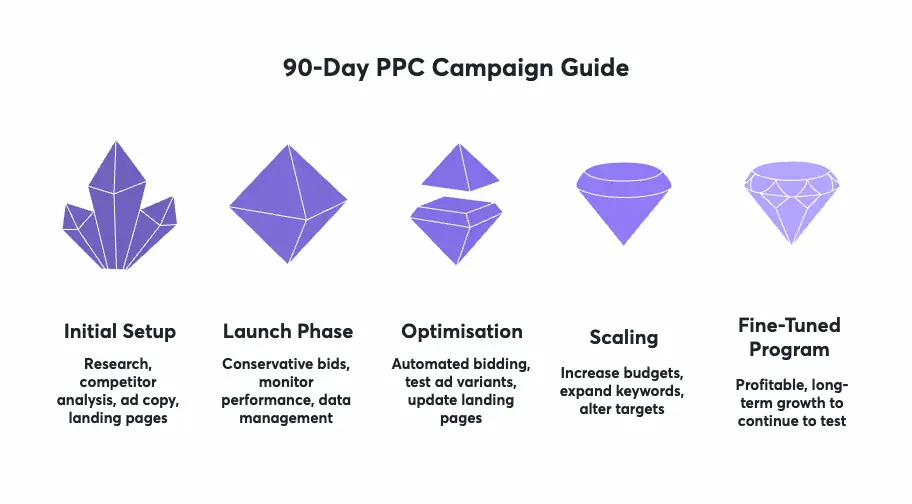
If you’re new to PPC, it’s wise to follow a structured game plan for the first few months. Here’s a 90-day starter guide to get your campaigns off the ground and running optimally:
- Days 1–10: Preparation. Do your research and set up work. Identify keyword themes, research your competitors’ ads, and create compelling ad copy and visuals. Build out dedicated landing pages for each campaign (with clear headlines and calls-to-action matching the ads). Also, set up conversion tracking by making sure your Google Analytics or Ads tags are tracking form submissions, phone calls, or e-commerce checkout events so you’ll capture results from day one.
- Days 11–30: Launch. Go live with your campaigns using conservative bids and budgets. Monitor closely for any issues. In these first weeks, comb through the search terms report to see what people are actually searching when they click (add negative keywords to weed out irrelevant traffic). Fix any “leaks” in your funnel. For example, if your contact form isn’t mobile-friendly or the checkout has a bug, address it promptly because those could cost you conversions. Early on, it’s all about gathering data and ensuring the campaign is running smoothly.
- Days 31–60: Optimise. By now you may have some conversion data. Consider switching to automated bidding strategies like Target CPA or Target ROAS if they fit your goals (these use Google’s AI to adjust bids toward your desired cost per lead or return). Continue testing new ad variants and try different headlines or offers to lift performance. This is a good time to extend into remarketing (show ads to past visitors) or YouTube if you have video assets to catch those who showed interest but didn’t convert initially. You might also test any learnings from month 1 (e.g. if one message worked better, apply it across more ads).
- Days 61–90: Scale. Now you have a clearer idea of which campaigns, keywords, and ads are working best. Increase budgets or bids for the high performers to capture more volume, especially if they’re hitting your target CPA/ROAS. Expand your keyword list to cover more variations or new profitable niches discovered in the search terms. Widen your geographic targeting if relevant (e.g. from city to nationwide, if a test in one region was successful). Import any offline conversions (sales made by phone or in-store that stemmed from PPC leads) to get the full picture of performance. Also, start refining budgets based on profitability and allocate more to campaigns with higher margins or better lifetime value. By day 90, you should have a much more finely tuned PPC program that you can continue to build on in the long term
If you’re unsure of all of the above and would like a dedicated ppc agency to support you, get in touch.
Common PPC questions for Businesses
Is PPC expensive for businesses?
Not necessarily. PPC budgets are very flexible, and how well they perform is down to the people managing them. You set the amount you’re comfortable spending. Start with a modest daily budget that you can afford, and aim for a cost per acquisition (CPA) that is profitable for you. Once you see positive results (e.g. acquiring customers for less than their value to you), you can always scale up. Many businesses begin with just smaller budgets on search ads to test the waters. The key is to monitor results and ensure your ad spend is yielding a return, then increase gradually once the ROI is proven.
How quickly will I see results from PPC?
Almost immediately, in terms of traffic. PPC ads can start driving visitors to your website within hours of launch. In fact, many advertisers get their first clicks on the same day the campaign goes live. For qualified leads or sales, it often takes a few days to start accumulating, simply as a function of how many people click and convert. Within the first week or two, you should have some early conversions if your campaign is set up well. Keep in mind that optimising for consistent, sustainable results may take a few weeks of tweaking and testing. PPC performance typically improves over time as you refine keywords, ads, and landing pages based on the data coming in.
Should I bid on my own brand name in PPC?
The answer to bidding on your own brand name really depends on whether your competitors are already bidding on you. Bidding on your name ensures that searchers looking specifically for your company find you first, not a competitor’s ad. The cost for brand clicks is usually very low (and Google rewards you with high-quality scores for relevance), and those visitors convert extremely well since they were already looking for you. It’s essentially easy, cheap traffic. However, if you have no competitors bidding on you, not doing it and using your budget on other transactional traffic is going to be a significantly greater use of spend than paying for clicks (and leads) you could get organically anyway.
Ready to improve your PPC Performance?
PPC can be a game changer for a growing business, but to truly succeed, you need to have the right expertise. If you’re considering launching a PPC campaign or seeking to improve results from your existing ads, we are here to help. We’re a full-service marketing agency with dedicated PPC specialists who know how to create and optimise campaigns that deliver real ROI. Whether you need help with initial campaign setup, ongoing optimisation, or integrating PPC into your overall marketing strategy, we’d be happy to chat about your goals. Feel free to get in touch for a friendly, no-obligation consultation.